Why SEO Timelines Matter for Architects & Designers
Architects and interior designers ask one big question about SEO:
“How long before this actually brings us clients?”
The answer isn’t a single date—it’s a timeline with phases. Knowing this matters because:
- Expectation alignment: You budget and plan more confidently.
- Strategic pacing: You balance fast wins with compounding gains.
- Focus calibration: You stop chasing vanity metrics and start measuring ROI.
This guide answers the most common SEO timeline FAQs for design firms—optimized for straight answers.
Key Takeaways
- SEO takes 3–6 months for traction, 6–12 months for ROI.
- Quick wins = early progress; long-term = lasting authority.
- Timelines vary by stage: new firm, expansion, or rebrand.
- SEO progress is non-linear—but trackable.
- Consistency compounds into real business growth.

How Long Does SEO Take for Architects & Design Studios?
It depends on your starting point—new firms need patience, established firms can accelerate.
- First signs: 2–3 months (rankings for low-competition keywords).
- Meaningful visibility: 4–6 months (traffic + inquiries).
- Full impact: 6–12 months (consistent leads, authority).
- New sites: May take 12–18 months.
If you want a clear picture of where your firm stands right now, Adswom’s visibility diagnostic shows exactly how long it will take for your site to turn traffic into inquiries.
What Are Quick SEO Wins vs. Long-Term Strategy?
Quick Wins (0–3 months)
- Metadata fixes, alt text, broken links.
- Improve site speed & mobile UX.
- Optimize Google Business Profile (GBP).
- Clean up citations (NAP consistency).
🎯 These give you early momentum.
Long-Term Strategy (3–12 months+)
- Pillar content + keyword clusters.
- Location/service landing pages.
- Backlinks from partners, press, associations.
- Consistent thought-leadership blogs.
🎯 This is where the compounding ROI kicks in.
Not sure how to balance quick wins with long-term SEO? That’s exactly what our Search-to-SQL framework was built for—getting you early traction while building long-term authority.
Why Does SEO Take So Long?
Because search engines need time to trust you.
- Crawling/indexing delays → Google has to find & process your site.
- Authority building → backlinks, reviews, and citations build slowly.
- Competition → established firms already occupy top spots.
- Compounding growth → SEO works like compound interest—stronger over time.
If you’re frustrated with “waiting games,” the fix isn’t shortcuts—it’s a smarter roadmap. We help design firms see progress markers at every stage so you’re never in the dark.
What Timeline Should Design Firms Expect?
| Timeline Phase | What Happens | Key Results |
|---|---|---|
| 0–1 Month | Audit + quick fixes | Setup complete |
| 2–3 Months | Local ranking movement | First signals |
| 4–6 Months | Content traction | Leads begin |
| 6–12 Months | Authority + backlinks | Consistent pipeline |
| 12–18 Months | Expansion | Compounding growth |
Want to know which phase your firm is in right now? Our free SEO timeline audit maps it out—so you know exactly what’s realistic for the next 12 months.
What Business Stages Match These Timelines?
- New Firm / Launch → 9–18 months (focus on GBP + local SEO).
- Established Studio → 6–12 months (scale into new markets).
- Rebrand / Relaunch → 3–6 months (quick wins to recover visibility).
Wherever your studio is—launching, scaling, or rebranding—our system adapts the SEO timeline to your growth stage.
What Factors Speed Up or Delay SEO Results?
Accelerators: existing authority, local keywords, backlinks, bigger budgets.
Delays: new sites, crowded cities, thin content, inconsistent execution.
Think of us as timeline engineers—we speed up what can be accelerated, and remove roadblocks that stall SEO progress for design firms.
Is SEO Progress Linear?
No—progress comes in spikes and dips. Month 2 might pop, Month 4 might dip, Month 6 stabilizes.
If you’ve been burned by “rankings up, then down,” we can help you track the trend line—not the noise.
How Do I Track Progress Without Losing Patience?
Track by milestones, not vanity metrics.
- 0–3 months → technical fixes & GBP impressions.
- 4–6 months → traffic growth & early inquiries.
- 6–12 months → leads & ROI.
We build monthly dashboards so principals and marketing leads can see progress in plain business terms—not just charts.
How Do I Explain SEO Timelines to Stakeholders?
- Use milestones, not percentages.
- Compare SEO to architecture: “You can’t show the structure before the foundation.”
- Highlight early wins like GBP calls.
- Tie metrics to revenue, not rankings.
We translate SEO into business language so your partners, principals, and investors stay aligned.
What Happens If We Stop SEO Midway?
- Stop early → rankings + leads decline.
- Stay consistent → SEO compounds into lower-cost leads.
Consistency compounds. That’s why our clients see SEO as infrastructure—not a campaign they turn on and off.
What to Do Next
- Run a Free SEO Timeline Audit → spot quick wins now.
- Plan a 12-Month SEO Roadmap → align growth + visibility.
- Commit to Monthly Check-Ins → keep leadership aligned.
🎯 At Adswom, we build SEO systems for architects & designers—so you see results in months, and leadership trusts the long-term growth curve.
👉 Book Your Free Timeline Strategy Session →
Beautiful Doesn’t Convert. Optimised Does.
Your website isn’t a portfolio. It isn’t a brochure. It isn’t just your brand story.
Your website is a conversion engine.
And if it’s not optimised to attract better inquiries, you’re just entertaining visitors, not converting them.
Here’s the mistake most design studios make: they obsess over pixels. But high-value clients don’t care about pixels—they care about outcomes.
This post will show you how to transform your design studio website into an inquiry-generating machine by:
- Aligning your message with buyer intent
- Engineering trust across every scroll
- Using SEO to attract qualified leads, not just traffic
- Turning visits into booked consultations
Let’s fix your site so it sells your studio—not just shows it off.
Key Takeaways: How to Optimise Your Studio Website for Inquiries
- Your site is a funnel, not a flier — guide visitors from awareness to action.
- Message clarity beats cleverness — say what you do, who you serve, and why it matters.
- SEO is about relevance, not volume — target high-intent, inquiry-driven keywords.
- Case studies double as landing pages — optimise each project for search + conversion.
- CRO drives revenue — small conversion lifts mean thousands in new business.
- Speed + UX = trust — slow or clunky websites kill credibility with premium clients.
- Contact page must pre-sell — it’s not a form, it’s a conversion tool.
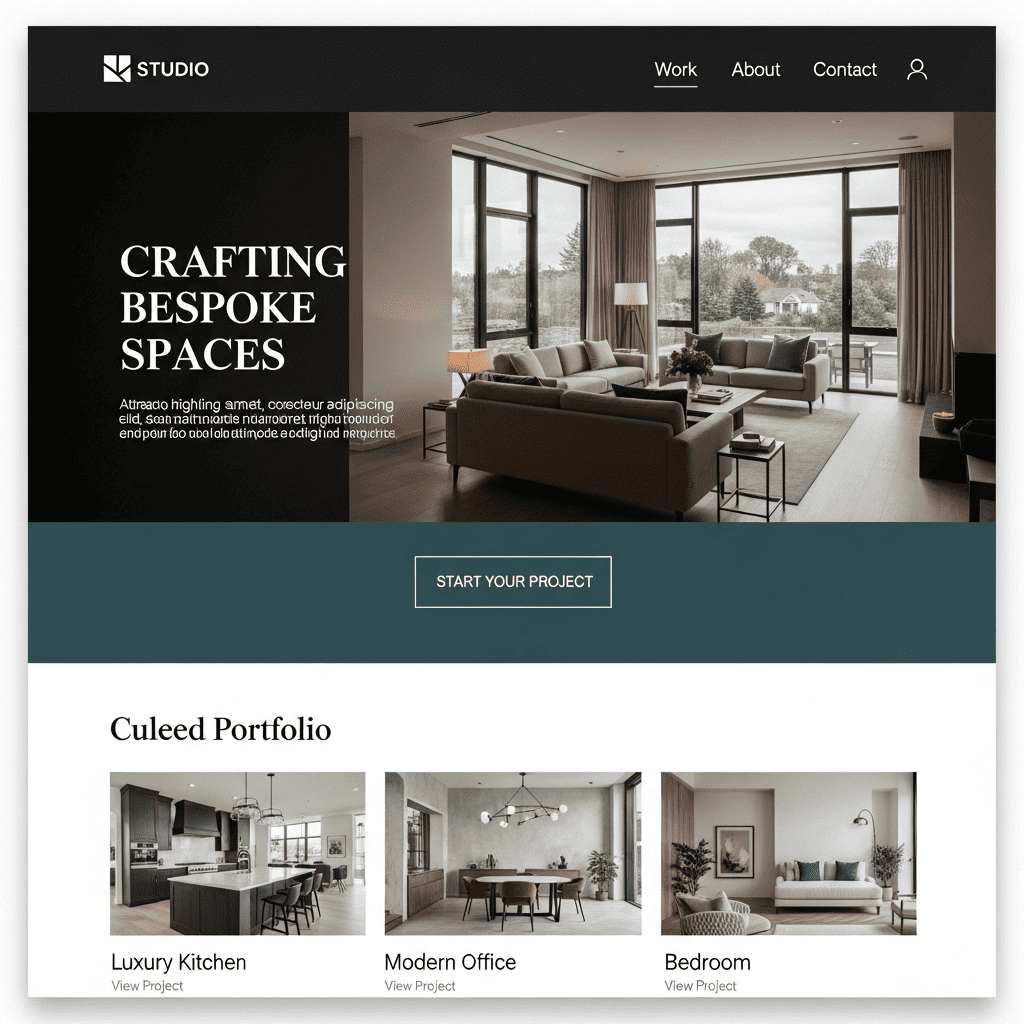
Your Website Is a Funnel, Not a Flier
Most studio websites look like glossy coffee table books—expensive lookbooks that impress peers but fail to generate inquiries.
Here’s the problem:
A stunning homepage with no conversion path is just digital decoration.
High-quality inquiries don’t come from hope. They come from structure.
Your Website Needs a Funnel: — think of the site as a layered strategy The 5 Layers Every Architecture SEO Strategy Must Include
- Top of Funnel (TOFU): Capture attention with value-driven content
- Middle of Funnel (MOFU): Build trust with proof (case studies, reviews, process)
- Bottom of Funnel (BOFU): Convert with frictionless CTAs, clear services, and strong value props
Ask yourself:
- Can someone figure out what you do in under 10 seconds?
- Can they contact you without frustration?
- Do they feel like you specialize in solving their problem?
If not, they leave.
Studio Website Funnel Done Right
| Funnel Stage | What Clients Are Doing | What Most Studio Websites Show | What an Optimised Website Should Do |
|---|---|---|---|
| TOFU (Top of Funnel) | Searching for ideas, exploring options | Pretty homepage images, vague taglines | Value-driven content (blogs, guides, style-specific insights) |
| MOFU (Middle of Funnel) | Comparing firms, checking credibility | Minimal case studies, no proof | Detailed case studies, reviews, process explanation |
| BOFU (Bottom of Funnel) | Ready to inquire | Weak contact form, hidden CTA | Frictionless CTAs, clear services, strong value props |
Your website isn’t just a gallery—it’s a guided journey from inspiration → trust → action.
Message-to-Market Match
You’re not a generalist. So why does your homepage sound like one?
The #1 reason studios attract poor inquiries: misaligned messaging.
High-value clients—luxury homeowners, developers, boutique brands—don’t want vague “we design spaces that inspire” fluff. They want clarity.
Optimise Your Messaging:
- Use clarity over cleverness:
- “We Design Homes That Sell for More” > “Crafting Spaces, Creating Stories”
- Add a qualifying subheadline:
- “We specialize in contemporary homes $1M+ in [region]”
- Lead with the result, not the aesthetics:
- Before: “We’re a multi-disciplinary studio blending form and function.”
- After: “We help developers maximize ROI with sustainable, sellable architecture.”
Message-to-market match attracts better-fit leads and filters out browsers. (If you need a template, see Writing Style Guides for Design Studios.)
SEO Isn’t Just Rankings. It’s Relevance.
You don’t have a traffic problem. You have a traffic-quality problem.
Most designers rank for irrelevant terms, so they get irrelevant inquiries.
High-Intent SEO for Design Studios:
- Target keywords with intent:
- “Interior designer for modern villas [city]”
- “Hire architect for boutique hotel”
- “Luxury residential design consultant”
- "For a practical approach, see Keyword Strategy for Architects"
- Build service pages + blogs around inquiry-driven search terms
- Align metadata with client pain points
This way, every visitor who lands is pre-qualified. SEO doesn’t just bring traffic. It brings the right traffic.
Wondering Why Your Website Isn’t Converting
At Adswom, we don’t just look at traffic—we analyse your inquiry funnel.
✅ We audit your inquiry journey from homepage to contact form
✅ We identify weak spots in SEO + UX
✅ We show you how to fix them
👉 Book Your Free Website Conversion Diagnostic →
No jargon. No pressure. Just clarity. → DIY SEO Audit for Architects & Designers
Show Don’t Tell—But Make It Searchable
A portfolio isn’t enough. High-value clients want proof, not just pretty images.
Each Case Study Should:
- Have its own page with a keyword-rich URL — see How to Make Your Portfolio Pages SEO-Friendly
- Include an H1 that matches the project type
- Use narrative copy: challenge → process → solution
- End with a CTA (“Book a Discovery Call”)
Bonus: Add testimonials, process visuals, or embedded videos to deepen trust.
When case studies double as optimised landing pages, they attract and convert. (See implementation: Turn Case Studies Into SEO Landing Pages.)
CRO (Conversion Rate Optimisation) Is How You monetise
A website that doesn’t convert is just a sunk cost.
Even a 1% increase in conversion rate = thousands in revenue.
CRO Moves That Matter:
- Above-the-fold clarity: What do you do + who do you serve?
- Sticky CTAs: Always visible on mobile
- Simplified forms: 3–4 fields max
- Trust signals: Testimonials, logos, certifications
- Micro-commitments: “Get a Free Estimate” > “Book a Call”
Measure the business impact of CRO and SEO together: How to Prove the ROI of SEO for Your Design Studio
CRO Mistakes vs. Fixes
| Common CRO Mistake | Conversion-First Fix |
|---|---|
| Generic “Contact Us” buttons | Sticky “Book a Consultation” CTA |
| Long, complicated forms | 3–4 fields, mobile-friendly |
| No social proof | Testimonials, client logos, accreditations |
| Above-the-fold hero image only | Above-the-fold clarity: what you do + who you serve |
CRO is where your site stops being a brochure and starts being a sales engine.
UX + Speed = Trust
Luxury clients don’t tolerate friction.
If your site is slow, clunky, or confusing, they bounce—no matter how good your work is.
UX & Speed Essentials:
- Mobile-first design (65% of traffic is mobile)
- Fast load times (<2.5s) — test with PageSpeed Insights and compress images with tools like ShortPixel
- One message per scroll (avoid text walls)
- Simple navigation (max 3 clicks to contact)
- High-quality, compressed images
For technical guidance tailored to image-rich portfolios, see Technical SEO for Image-Rich Portfolio Sites.
A clean, frictionless experience is the baseline expectation for premium clients.
Your Contact Page Should Pre-Sell
Most firms treat the contact page as an afterthought. Huge mistake.
Your contact page should act like a landing page.
Optimise for Conversion:
- Add trust signals (testimonials, accreditations, logos)
- Repeat your value proposition above the form
- Pre-frame expectations: “We typically respond within 1 business day.”
- Add qualifying FAQs (“What’s your budget?” “How long does the design process take?”)
Your contact page should qualify leads while you sleep. For page-level design that converts, see SEO-optimised lead-generating pages.
What High-Converting Design Studio Websites Share
From auditing 100+ design studio websites, here’s the pattern:
- Clear, specific messaging (not vague jargon)
- SEO that targets client intent (map queries to value with Keyword to SQL: Mapping Intent to Inquiry)
- Pages built to convert, not just inform
- Trust signals layered throughout
- UX optimised for speed + simplicity
You don’t need more awards. You need better alignment between your:
- Website
- Audience
- Revenue goals
Optimising Your Studio Website for Inquiries
What’s the #1 reason studio websites fail to generate leads?
Lack of clarity. If visitors can’t tell what you do, who you serve, or how to engage within 10 seconds, they bounce.
How does SEO help improve inquiry quality?
SEO attracts people already searching for your services. By targeting long-tail, intent-driven keywords, you filter out browsers and attract decision-makers. See Keyword Strategy for Architects
Should I redesign my website or optimise the existing one?
Start with optimisation. Fix messaging, UX, speed, and SEO before a redesign. Often, the issue is structure, not style. (Practical steps: Optimise your studio website for inquiries.)
What pages matter most for conversion?
Homepage, services, case studies, and contact. These must have CTAs, proof, and clear value props. See examples in SEO-friendly architecture portfolio
What’s a good conversion rate for design studios?
2–5% is a strong benchmark. With CRO + SEO alignment, studios often go higher depending on offer and audience. Use industry KPIs: Must-Have SEO KPIs for Architecture Firms
Make Your Website Earn Its Keep
Design studios don’t have a visibility problem. They have a conversion problem.
If your site looks beautiful but fails to attract the right inquiries, it’s time to optimise it.
Align your message with the right client
- Optimise every click path toward a CTA
- Use SEO to attract qualified traffic
- Build trust with case studies + content
- Treat your contact page like a sales rep
👉 Start with your Free Visibility Diagnostic.
Your website isn’t a portfolio. It’s a profit centre. Treat it like one.